Reading a Casino Scene Without Mistaking It for a Map
Read a casino scene with a sharper eye: trace its cuts, sound and props to see how the film builds suspense without treating fiction as venue fact.
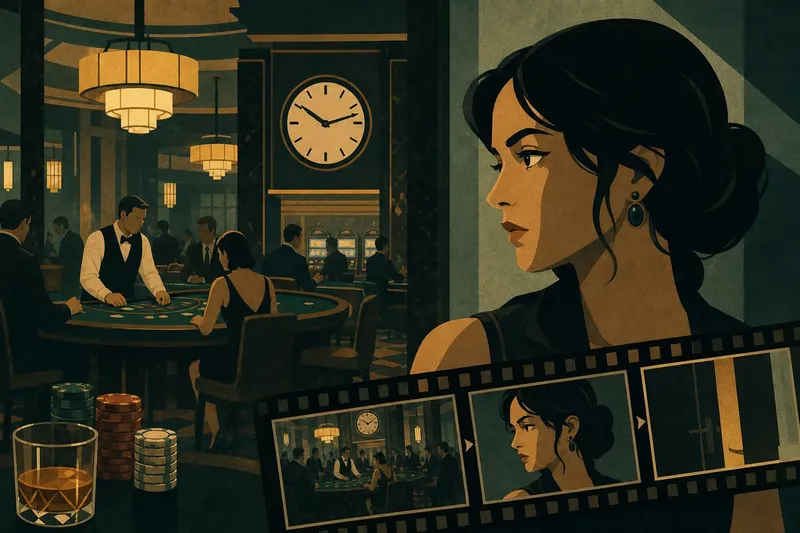
What does a casino scene make you expect before anything happens? Reading a casino scene closely means tracing how a film builds suspense through sound, timing and visual information. The room is not simply a backdrop; its details can set a viewer’s expectations, then confirm or unsettle them.
Think of the sequence as a sealed envelope. The filmmaker controls what enters the frame and when, while details beyond it remain unknown. That limit lets you describe the film’s design without treating a fictional room as evidence about real venues.
Sound makes the room feel watchful or exposed
Listen for what the soundtrack brings forward. A conversation may sit above a low mechanical hum, or a small sound may become conspicuous when the music drops away. Those choices direct attention and create a particular mood.
Notice whether the sound seems to belong to the room or to the film’s score. A bell, shuffle or announcement can provide a scene with a sense of place. A sustained musical note may instead tell you how to feel about an approaching decision.
Sound can also narrow your attention. If background noise fades during a character’s pause, the moment may seem private even in a crowded frame. That is an effect of mixing, not proof that the room has gone quiet.
Framing controls what the viewer is allowed to know
A wide shot can establish several people and objects at once. A close-up can withhold the broader situation while making a hand, face or card seem decisive. Ask what information each shot provides and what it keeps outside the image.
Focus matters too. When one figure is sharp and the others blur, the scene asks you to attend to that person. A change of focus can redirect attention without any character moving.
Camera movement may make a room feel stable, crowded or disorienting. Describe the movement itself before assigning a meaning: the camera follows a character past tables, for instance, or remains still while people cross the frame. The effect belongs to the sequence’s construction.
Cutting turns separate images into suspense
Editing determines how long you see a face, an object or the space between them. A quick cut can make reactions feel connected; a held shot can leave a question hanging. The sequence shapes suspense by arranging these images, not by documenting a standard way people behave.
Pay attention to what follows a significant line or action. A cut to a closed door may suggest that the character has limited options. A return to the table may shift attention back to the decision at hand.
Continuity can be useful to examine. If an object seems to change position between cuts, the shift may be a production inconsistency or an intentional ellipsis. Unless the story makes the meaning clear, describe the discrepancy without assigning a motive.
Colour and set design establish a visual argument
Look for repeated colours and contrasts. Warm light beside a cold corridor, for example, can make two parts of the same set feel distinct. That contrast may support a story’s movement from ease to unease.
Set details also establish what the film wants you to notice. A prominent clock, mirrored wall or doorway can serve as a visual motif. Its significance depends on how the film uses it across the sequence, not on what similar objects mean in every casino.
Costume and décor can place a scene within a chosen style or period. They are evidence of the production’s design choices. They do not, by themselves, establish how a real venue is furnished or managed.
Check each interpretation against what appears on screen
For each detail, record what is visible or audible, then decide how far it supports an interpretation. If the evidence is uncertain, keep the description narrow.
- Sound cue: Check whether the sound is clearly heard and whether it recurs. If it is distinct and repeated, discuss its possible role in the sequence; if it is faint or isolated, describe it without assigning significance.
- Camera distance: Check whether the shot is wide, medium or close. If the framing clearly excludes surrounding action, note what information is withheld; if the crop is unclear, avoid claiming the film deliberately hides something.
- Focus: Check which subject appears sharp. If focus shifts between people or objects, describe the change in attention; if the image is soft throughout, do not infer a deliberate emphasis.
- Cut order: Check what image follows a line or action. If the cut links two visible reactions, discuss that edit; if the connection is uncertain, describe the order without claiming cause.
- Colour contrast: Check whether a colour or lighting contrast recurs. If it returns at a related story moment, consider a visual pattern; if it appears once, treat it as a local design choice.
- Set object: Check whether an object is framed prominently or revisited. If the film returns to it, consider whether it links scenes; if it remains in the background, avoid presenting it as a plot clue.
Say you are watching an invented scene in which a character named Nia enters a casino set while a low piano note continues. The camera first holds a wide view with a clock above the tables, then cuts to Nia’s face as the music stops. You can record three inputs: one continuing note, one wide shot, and one close-up after the music cuts. First, describe the audible change and the shot order. Next, note that the close-up follows the silence. The scene supports the reading that the edit directs attention to Nia’s reaction at that moment. It does not establish why she feels as she does, what the clock signifies, or how a real casino sounds.
What can the film’s design tell you?
Does casino background sound describe a real venue?
It describes the soundtrack in that scene. A film may heighten, soften or replace sounds to suit its pacing, so treat the audio as a creative choice rather than a record of ordinary conditions.
Why might a film keep a detail out of view?
Framing can preserve uncertainty or direct attention elsewhere. If the scene never supplies the missing information, leave the gap open instead of filling it with an assumption.
Can colour alone reveal a character’s motive?
No. Colour can contribute to mood or visual structure, but it cannot establish a private intention on its own. Look for support in the surrounding images and story events.
What if a prop appears to move between cuts?
Describe the difference you can see and consider whether the sequence skips time. If the film offers no explanation, leave the cause unresolved rather than treating a continuity change as a clue.
Keep production choices distinct from venue facts
Films construct casino spaces through locations, sets, props, lighting and sound design. A table layout or uniform may serve the story’s period and visual style. It cannot establish how a working venue is arranged or what its staff would do.
Choose language that keeps the distinction clear. “The score drops out as Nia enters” describes an audible event. “Casinos fall silent when someone arrives” turns a film choice into an unsupported claim about venues.
For a casino scene, the main search phrase is most useful when it leads to a precise question: how does this particular sequence guide attention? Trace the sound, frame and cut that shape the moment. The production choices can carry meaning without being mistaken for a map of real places.