What a Turn Is Made to Do in a Casino Game
Casino game turn structure shows whose decision is live and which choices remain open, helping you read the table without confusing action with outcome.
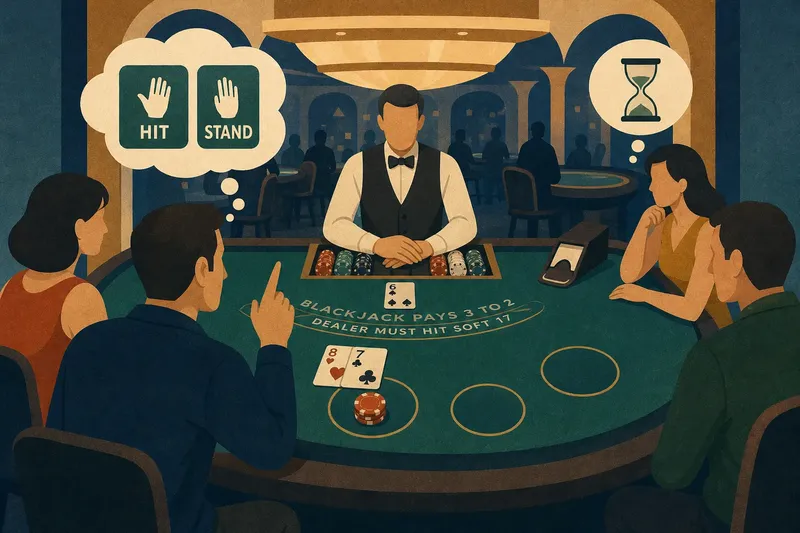
At a blackjack table, one player may be deciding whether to draw while the others wait. Casino game turn structure makes that moment legible: it identifies whose choice is live and what happens when the choice is made.
Turn structure identifies the decision-maker
A turn is a recognised opportunity to make a decision or take an action. The rules define who has it, what options are available and what closes that opportunity. A round is broader: it may contain several players’ decisions, shared events and a dealer’s actions.
In blackjack, for instance, a player acts on their hand before the dealer follows the table’s rules for the dealer’s hand. The exact options depend on the game’s rules. The useful distinction is between the player’s decision and the dealer’s later procedure.
Think of a turn like a place setting at dinner. The setting does not decide what anyone orders; it shows whose moment it is to choose.
Game formats assign decisions in different ways
Some casino formats give each player a separate decision. Others centre on shared events, such as revealing a card, or on an operator carrying out a rule-governed action. A game can therefore have a clear structure even when no player is choosing at every moment.
Keep three things distinct as you watch: the person entitled to act, the options allowed by the rules, and the event that moves the game forward. A reveal may change what is known without opening another choice. A dealer’s action may settle a hand without being a player’s turn.
Rules, not table mood, mark the end of a turn
A turn ends when the game’s rules recognise a choice or other defined event as complete. Depending on the format, that cue might be a declared action, a dealer instruction, a reveal or a settlement. The cue matters because it distinguishes an open decision from one that has passed.
Other players may watch, chat or wait while someone decides. Their reactions do not change who is entitled to act. If the procedure is unclear, a player can ask the dealer to explain the available options or indicate whose decision is next.
Turn structure in casino games raises a few questions?
Does every casino game give each player a turn?
No. Some games give players individual choices, while others progress through shared events or dealer actions. The rules still establish how the game moves from one event to the next.
Is a turn the same as a round?
No. A turn is a particular opportunity to act; a round is a larger unit that may contain several turns and other events. The exact meaning can vary by game, so the table’s rules provide the working definition.
Can the available choices change during a game?
Yes. A game may offer different options at different points, or no player choice at all during a particular phase. Check the current rules and dealer instruction rather than assuming an earlier option remains available.
What should a new observer watch for?
Notice who is entitled to act, which choices the rules allow and what event closes that decision. This helps separate a player’s choice from the actions that follow it.
A worked example separates choice from outcome
Imagine an invented blackjack hand in which the table rules allow a player to hit or stand. The starting situation is one player with a live hand, the dealer waiting, and both options still open. The player says “stand”; that declared choice closes their decision, so the next action is the dealer’s procedure under the table rules. The observable result is a change in who acts, not a prediction about which hand will win. The decision rule is simple: if the player has declared an allowed choice, treat their decision as closed; if no choice has been made, do not treat the dealer’s turn as active.
Casino game turn structure is easiest to read when you separate the entitlement to choose from the events that follow. Once you know whose decision is live, the table’s sequence becomes clearer without mistaking a pause, a reveal or a result for another turn.